Baker Plumbing

- PlumBob
- Calgary, Alberta, Canada
- I've been involved in Plumbing, Heating & Gasfitting since birth!! Our Company has been serving the Greater Calgary area since 1956. If We Cant Do It, It Cant Been Done! We have completed projects across Canada from Kelowna to Toronto. Give us a call and see what we can do for you!
Tuesday, December 3, 2013


Monday, May 7, 2012
A warm welcome to Spring/Summer it is wonderful to feel the warmth of the Sun and see the flowers and trees starting to bud. It makes one glad to be alive.

 In fact this picture above shows someone trying to flush a roll of brown paper towel. Folks that is not going to happen.
Although we appreciate the business please think before you decide to flush. Not everything disappears after you flush it.
If you happen to be the victim of someone's careless flushing, give us a cal 24/7 we're to get things moving again.
All the best!!
Baker Plumbing
That said I want to chat quickly about toilets. There is no doubt that toilets and plumbers seem to go together like PB&J. Where would modern society be without the invention of the toilet and modern plumbing?? Imagine sitting in a high level meeting and needing to excuse one's self to use a bucket or worse yet run out to the outhouse. I may be basis but the start of modern society began with a bathroom upgrade. So why is it that we treat our bathroom fixtures so poorly?? We have found everything from old style pagers

To several rolls of toilet paper flushed all at once.

Although we appreciate the business please think before you decide to flush. Not everything disappears after you flush it.
If you happen to be the victim of someone's careless flushing, give us a cal 24/7 we're to get things moving again.
All the best!!
Baker Plumbing
Tuesday, January 10, 2012
Septic Fields/Tanks and Freezing
Question#2 How do I keep my septic field or tank from freezing?
Thanks to Martin for asking this question.
The use of septic fields goes back a hundred years or so. The first ones were very simple holding containers that would eventually leach into the ground. I even saw a septic tank made out of an old car (I wish I had pcitures of it). Anyway the tank and piping of a septic tank usually are not buired very deep. Typically between 18" to 36" for the pipe and 6' to 8' for the bottom of the tank.
As long as the tank is being used you should have no problems with the tank or lines freezing. The bacteria that break down the effluent (poo and other assorted materials) create quite a bit of heat which keeps everything toasty. I couple of rules to remember though.
1. Keep all traffic off the drain line from the house to septic, the septic tank and field. That includes foot traffic, horses, cars, anything with weight to it that can drive the frost further into the ground causing freeze ups.
2.Straws bales can be your best friend. Piling bales over the tank and building sewer can further insulate the lines and protect them.
3.Keep your field manicured (cut the grass). This helps aid the transfer of gases that the bacteria create to the atmosphere and will keep your field fit and operational.
Some Do Not's
1.Do not add anti-freeze, salt or a spetic additive to system.
2.Do not pump sewage to the surface.
3.Do not start a fire over the system to unthaw.
4.Do not run water continually to unfreeze.
A typically system looks something like this.


Thanks to Martin for asking this question.
A septic system is a highly efficient, self-contained, underground wastewater treatment system. Because septic systems treat and dispose of household wastewater onsite, they are often more economical than centralized sewer systems in rural areas where lot sizes are larger and houses are spaced widely apart.  | |
| A septic system consists of two main; a septic tank and a drainfield. The septic tank is a watertight box, usually made of concrete or fiberglass, with an inlet and outlet pipe. Wastewater flows from the home to the septic tank through the sewer pipe. The septic tank treats the wastewater naturally by holding it in the tank long enough for solids and liquids to separate. The wastewater forms three layers inside the tank. Solids lighter than water (such as greases and oils) float to the top forming a layer of scum. Solids heavier than water settle at the bottom of the tank forming a layer of sludge. This leaves a middle layer of partially clarified wastewater. The layers of sludge and scum remain in the septic tank where bacteria found naturally in the wastewater work to break the solids down. The sludge and scum that cannot be broken down are retained in the tank until the tank is pumped. The layer of clarified liquid flows from the septic tank to the drainfield or to a distribution device, which helps to uniformly distribute the wastewater in the drainfield. A standard drainfield (also known as a leaching field, disposal field, or a soil absorption system) is a series of trenches or a bed lined with gravel or course sand and buried one to three feet below the ground surface. Perforated pipes or drain tiles run through the trenches to distribute the wastewater. The drainfield treats the wastewater by allowing it to slowly trickle from the pipes out into the gravel and down through the soil. The gravel and soil act as biological filters. | |
The use of septic fields goes back a hundred years or so. The first ones were very simple holding containers that would eventually leach into the ground. I even saw a septic tank made out of an old car (I wish I had pcitures of it). Anyway the tank and piping of a septic tank usually are not buired very deep. Typically between 18" to 36" for the pipe and 6' to 8' for the bottom of the tank.
As long as the tank is being used you should have no problems with the tank or lines freezing. The bacteria that break down the effluent (poo and other assorted materials) create quite a bit of heat which keeps everything toasty. I couple of rules to remember though.
1. Keep all traffic off the drain line from the house to septic, the septic tank and field. That includes foot traffic, horses, cars, anything with weight to it that can drive the frost further into the ground causing freeze ups.
2.Straws bales can be your best friend. Piling bales over the tank and building sewer can further insulate the lines and protect them.
3.Keep your field manicured (cut the grass). This helps aid the transfer of gases that the bacteria create to the atmosphere and will keep your field fit and operational.
Some Do Not's
1.Do not add anti-freeze, salt or a spetic additive to system.
2.Do not pump sewage to the surface.
3.Do not start a fire over the system to unthaw.
4.Do not run water continually to unfreeze.
A typically system looks something like this.

Some of the restrictions for installing a septic fields are outlined here.

Monday, January 9, 2012
Shower drains
Unclogging a Slow Shower Drain


Everyone has had that moment: standing in the shower, washing your hair, when suddenly, water is up to your ankles. A drain clog! Hopefully not as bad as our picture above. Typically, a buildup of hair, by itself or combined with bath product gunk, is to blame. In this situation, many reach for the Drano. Instead of turning to harsh chemicals that might damage the finish of your tub or eat away at your pipes, try looking to some simpler (and possibly more effective) solutions first.
Before any tools or concoctions make an appearance, try sticking your fingers in the drain. If the hair is up near the top, this might be all it takes to fix the problem. You’d be surprised at how effective fingers can be as a hair removal apparatus. I doubt it if it will be as obvious as below!

There are two tools you can try if you can’t fix the problem that way, one of which you already own, and one that you can buy at the hardware store for under ten bucks. The first is a plunger. Try using it just as you would on a toilet, and see if the clogging culprit comes to the surface in the drain. The second is called a Drain Claw, and it is essentially a piece of wire with barbs on the end for catching hair. Stick one down the drain, twist it around a few times, and pull it out. Repeat until you stop pulling out hair, and run some water to test whether the clog is gone. You can even try to make your own out of a metal clothes hanger and go do some fishing.

There are two tools you can try if you can’t fix the problem that way, one of which you already own, and one that you can buy at the hardware store for under ten bucks. The first is a plunger. Try using it just as you would on a toilet, and see if the clogging culprit comes to the surface in the drain. The second is called a Drain Claw, and it is essentially a piece of wire with barbs on the end for catching hair. Stick one down the drain, twist it around a few times, and pull it out. Repeat until you stop pulling out hair, and run some water to test whether the clog is gone. You can even try to make your own out of a metal clothes hanger and go do some fishing.


If the clog persists, it might be time to move on to a homemade clog-busting concoction. Pour one part baking soda down the drain, and follow it with one part vinegar. That’s right- the same as your kid’s model volcano. Wait until the foaming subsides, and follow that with boiling water. This method is effective when bath product gunk, rather than hair, is the problem.
I've added some pictures of typical plumbing system so you visualize what's happening under the floor.
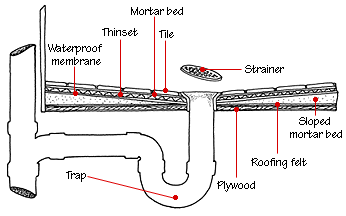

Whatever you do, don't add nasty chemicals that can potenital melt your pipes or destroy appliance finishes..

After all this, if your shower is still not draining properly, it’s probably time to call in the pros. Baker Plumbing can handle any clog you throw at us, quickly and professionally. Give us a call
Wednesday, November 23, 2011
Some of the Craziness we have seen this year
I thought we would compile some pictures of some the crazy, weird, and frankly nastiness we have come across this year. So sit and enjoy, well maybe prepare yourself some of these pictures are not for the faint of heart.
#10.
 This one is awesome. This poor lady hired a licensed plumber to install this sink for her, she was charged $1700 and the plumber claimed that the inspector approved this installation. Of course she wasn't home when the inspector supposedly showed up. There is so much wrong with this I can't even begin to point it all out.
#9
 Yes, that is an egg by the power feed! The request for service was that the roof top unit is making a funny sound. Well, somehow a family of pigeon made their way into the unit and built themselves a little home. All was well until the thermostat turned the unit on.
#8 - This one is of the actual squirrel cage
 No explanation needed!
#7
 We've shown this one before but it's a good one. This picture is of a 8' deep man hole that is now full to the top with all sorts of nastiness.
#6
 Its always amazes me the stuff you find in peoples storage room, mechanical rooms, etc.. All the places the public normally doesn't go. If my wife would allow it I could take pictures of the thousands of ladies that are plastered all over the walls of these same rooms.
#5
 Anyone feel like taking a bath? Is there really anything nastier than a tub full of poo?? Anyway, look away if you can't take it.
#4
 How many fittings does it take to go around a pipe? By this guy's math-6-Awesome!
#3
 The power of water and cold weather.This little expansion tank was blown to bits and caused quite a little stir when it flooded the restaurant.
#2
 The list wouldn't be complete without the classic plugged toilet. Although this one shows someone needs more fiber!
#1
 This one is both nasty and tragic. Poor cat went into the furnace to stay warm and I'm sure enjoying his new found until the furnace motor started. No doubt it ended quickly.
As you can see it was an eventful year! Check this blog often or follow us on Twitter to keep abreast of the wild and wacky world of Baker Plumbing.
Until next time!!
#10.

#9

#8 - This one is of the actual squirrel cage

#7

#6

#5

#4

#3

#2

#1

As you can see it was an eventful year! Check this blog often or follow us on Twitter to keep abreast of the wild and wacky world of Baker Plumbing.
Until next time!!
Friday, October 21, 2011
GREASE TRAPS - The Nastiest of all plumbing jobs
If you've ever been involved with the restaurant industry, hospitality game or sort of maintenance gig then you've probably run across the dreaded grease trap. If you have no idea what we're talking about then stay tuned.
A grease trap is a vital component of your commercial or industrial plumbing system. Designed to protect the common sanitary system of malls, commercial buildings, and even cities. Without diving into the good and bad elements of the North American diet, it goes without saying that most of the most we eat contains various types of fat. In fact, fat or lye type products are a part of everyday life. Whether its cooking, cleaning the dishes or cleaning the floor, fat or fat type products makes it taste better, look awesome, and clean it up better. That fat causes very little problem while it is warm and liquid the trouble begins when it begins to cool down and solidify. Once it does that it can become a menacing problem for the operation of the restaurant, hotel, or whatever industrial operation it effects.
How does it work? In its simplest form a grease slows the water flow down to allow the "grease" products to float to the top of the chamber while allowing the water to flow underneath. That grease accumulates at the top of the grease trap until eventually it is cleaned by removal. I've included a picture here of a typically trap that we at Baker Plumbing have installed hundreds of times. While there are many different styles and types of traps. This unit provides a simple look at how it works.
 As with all mechanical devices its important that there are maintained properly. We suggest that your grease trap be cleaned no more than every 3 to 4 months. Doing it more often prevents the trap from doing its job effectively and can potentially cause more harm than it solves.
We thought it would be applicable to add a couple of pics of what can happen if your grease traps are not maintained or heaven forbid not installed at all.
 Above is a picture of a city manhole and Yes! they are typically 6 to 8 feet deep in Calgary. So what your looking at is 8 feet of grease. We were able to get this looked after for this client but if the city got involved they would be looking at quite possibly a $20,000 bill.
 This one is of a grease trap inside a restaurant that was actually installed backwards. Long story short the lid blew off and the grease filled the entire pit. Not very nice. We were able to make the necessary repairs and so far neither this location nor the one with the manhole problem has had any further issues.
If you have questions about your grease trap or concerns about its operations. Give us a call at Baker Plumbing and we'd be happy to ensure everything is as it should be. Till next time!
A grease trap is a vital component of your commercial or industrial plumbing system. Designed to protect the common sanitary system of malls, commercial buildings, and even cities. Without diving into the good and bad elements of the North American diet, it goes without saying that most of the most we eat contains various types of fat. In fact, fat or lye type products are a part of everyday life. Whether its cooking, cleaning the dishes or cleaning the floor, fat or fat type products makes it taste better, look awesome, and clean it up better. That fat causes very little problem while it is warm and liquid the trouble begins when it begins to cool down and solidify. Once it does that it can become a menacing problem for the operation of the restaurant, hotel, or whatever industrial operation it effects.
How does it work? In its simplest form a grease slows the water flow down to allow the "grease" products to float to the top of the chamber while allowing the water to flow underneath. That grease accumulates at the top of the grease trap until eventually it is cleaned by removal. I've included a picture here of a typically trap that we at Baker Plumbing have installed hundreds of times. While there are many different styles and types of traps. This unit provides a simple look at how it works.

We thought it would be applicable to add a couple of pics of what can happen if your grease traps are not maintained or heaven forbid not installed at all.


If you have questions about your grease trap or concerns about its operations. Give us a call at Baker Plumbing and we'd be happy to ensure everything is as it should be. Till next time!
Monday, July 25, 2011
A word on softeners.
We have in the last month installed a dozen softeners! They seem to come in bunches so I thought it would be prudent to include a blog on softeners. So without further adieu.
Water softening systems can reduce the calcium and magnesium content in your household plumbing. These and other elements cause water to become hard. Hardness can lead to various problems when limescale build up in your pipes and plumbing fixtures. Hard ions also does not interact well with soap in your washer, dishwasher and when you shower.
Typical home water softening appliances depend on an ion exchange resin wherein hard ions are replaced with sodium ions which soften liquid. Hard water causes a lot of problems with your plumbing and home appliances but can also be beneficial to your health by providing your body with magnesium and calcium and by reducing the solubility of toxic metals such as copper and lead.
Water softening methods usually rely on removing calcium and magnesium with the use of a solution or by replacing hard ions with sodium. By removing the hard ions, the liquid that runs through your household plumbing are unable to form limescale deposits that block your pipes and build up in your coffee makers and shower heaters.
You can also remove hard ions by distilling your water, but this proves to be way too expensive for household use. Softening systems can do this for you the cheap way. Sodium, the main and most common softening ingredient is readily available everywhere. You can find sodium resin and beads at a hardware store or at the supermarket.
Once your water is softened, your soap and detergent will dissolve easily in your dishwasher or laundry washer. You will get cleaner glassware and clothing. Even your bath soap and shampoo will lather better and you can feel cleaner after each bath. Home appliances that use water like a coffee maker of shower heater will last longer and work efficiently.
Water is softened in a water softening system by letting it pass through a bed of resin beads made from sodium or salt. Negative charged resins absorb metal ions which are replaced with soft ions that are released into the water. The positive ions found in sodium beads are also found in other elements like hydrogen and potassium.
Potassium should be used in households where people are on a salt restricted diet. There are also other resins that can be used with your water softening system that also absorb carbonate, sulphate and bi-carbonate ions. These kinds of resins release hydroxyl ions. These resin beads can be used in conjunction with sodium softening beads.
Before purchasing a water softener for your home, find out what you need from your machine. If you have people at home who have heart or kidney problems, then you should stick to potassium softeners and avoid using sodium. If you have metals in your water, then add other resins that can also get rid of these harmful metals.
For any further questions on softeners give us a call at 4032797554 or visit us at www.bakerplumbing.ca Friday, June 10, 2011
Wednesday, May 25, 2011
Thursday, May 19, 2011
Monday, May 16, 2011
Wednesday, May 11, 2011
Tuesday, May 10, 2011
Saturday, February 19, 2011
The Plumbing Consultant
Plumbing is something that everyone needs to deal with. Every person some time or the other needs the help and assistance of plumbing consultants. These plumbing contractors can give you the best plumbing solution.
Plumbing consultants are people that come up and give you plumbing advice. They are the people who can tell you the exact problems of your plumbing. The plumbing consultants not only solve problems related to the plumbing field, they can also do many things in the areas where the plumbing is concerned. However, there are many reasons why you should hire a plumbing contractor. Read as we give you the reasons.
You need to consult a plumber for new construction of your home. Having the consultant at the site would make you know what you need to do or which direction you should take the plumbing. You should always consult a plumber to get the plumbing work done.
If you have plans of remodeling your bathroom or kitchen, you should hire a plumbing contractor. With the help of the plumber, you will be able to know the best way to get the work done and moreover, if remodeling will be possible or not. Call the consultant before you start the work to save money and time in the long run.
If your pipe is leaking under your home which is being impossible for you to fix up, then it’s the time to contact a plumbing consultant. They by coming to your home will give you the best piece of advice of how to get your pipe fixed and keep them away from leaking.
You may sometimes face problem with plumbing and you may simply do not want to handle it yourself. What should you do then? Call the plumbing consultant to get the job done for you. Their help and assistance will keep you away from crawling under the house to get the work done.
Moreover, if you have plans to install bathtub, water heaters, shower, sinks or faucet in your home; call the plumbing consultant to get your work done smoothly. Just be sure to find the plumber that is knowledgeable about the part you are planning to do in your home. Make sure that the plumber you have hired knows the best way for the installations and the plumbing to be handled at the same time. A reputable plumbing consultant can surely help you out with this.
So, there are many reasons for which you may need a plumbing contractor. These plumbing consultants are more than just a mere plumber. They can get your work done smoothly if you do not want to mess it up yourself. So, it is best to consult them whenever you are faced with some plumbing problems. They will take money for their help and assistance but you will find that they worth the price for the work they have done for you.
For all your Plumbing, Heating, Gasfitting and HVAC needs call the "consultants" at Baker Plumbing!
http://www.bakerplumbing.ca/
Plumbing consultants are people that come up and give you plumbing advice. They are the people who can tell you the exact problems of your plumbing. The plumbing consultants not only solve problems related to the plumbing field, they can also do many things in the areas where the plumbing is concerned. However, there are many reasons why you should hire a plumbing contractor. Read as we give you the reasons.
You need to consult a plumber for new construction of your home. Having the consultant at the site would make you know what you need to do or which direction you should take the plumbing. You should always consult a plumber to get the plumbing work done.
If you have plans of remodeling your bathroom or kitchen, you should hire a plumbing contractor. With the help of the plumber, you will be able to know the best way to get the work done and moreover, if remodeling will be possible or not. Call the consultant before you start the work to save money and time in the long run.
If your pipe is leaking under your home which is being impossible for you to fix up, then it’s the time to contact a plumbing consultant. They by coming to your home will give you the best piece of advice of how to get your pipe fixed and keep them away from leaking.
You may sometimes face problem with plumbing and you may simply do not want to handle it yourself. What should you do then? Call the plumbing consultant to get the job done for you. Their help and assistance will keep you away from crawling under the house to get the work done.
Moreover, if you have plans to install bathtub, water heaters, shower, sinks or faucet in your home; call the plumbing consultant to get your work done smoothly. Just be sure to find the plumber that is knowledgeable about the part you are planning to do in your home. Make sure that the plumber you have hired knows the best way for the installations and the plumbing to be handled at the same time. A reputable plumbing consultant can surely help you out with this.
So, there are many reasons for which you may need a plumbing contractor. These plumbing consultants are more than just a mere plumber. They can get your work done smoothly if you do not want to mess it up yourself. So, it is best to consult them whenever you are faced with some plumbing problems. They will take money for their help and assistance but you will find that they worth the price for the work they have done for you.
For all your Plumbing, Heating, Gasfitting and HVAC needs call the "consultants" at Baker Plumbing!
http://www.bakerplumbing.ca/
Friday, February 4, 2011
Finding that Reliable, Emergency Plumber
Plumbing is one service that everyone needs at some point. You may have to find a dependable plumbing service very quickly if any emergency situation arises. It is better that you know some companies whom you can always rely upon. In today's web world it is not at all difficult to locate such a service.
Most of the plumbing services have online presence and hence finding them is very easy. You can contact them easily and obtain free estimates also. They provide a host of services encompassing domestic and commercial plumbing and heating projects too. So, if you require shower installations or new bathroom installations or repair to hot water tanks you can depend on these companies.
Even for all your drainage problems these companies can provide suitable solutions. They are mostly open 24X7 and can really prove helpful in times of crisis. And hence can cater to all sort of plumbing emergencies with a great ease. All you need to do is to call them up and within no time you will find one of the best and most skilled plumber at your doorstep.
The companies schedule their work according to your convenience. Their technicians first take a stock of the situation to identify the problem with your drainage system. Drain cleaning and repair is their area of expertise and you can rest assured that they will handle the project with utmost professionalism. They will provide you with suggestions for maintaining the drains also. Since their business is built on the cornerstone of customer satisfaction your contentment is always guaranteed.
Most of the plumbing services have online presence and hence finding them is very easy. You can contact them easily and obtain free estimates also. They provide a host of services encompassing domestic and commercial plumbing and heating projects too. So, if you require shower installations or new bathroom installations or repair to hot water tanks you can depend on these companies.
Even for all your drainage problems these companies can provide suitable solutions. They are mostly open 24X7 and can really prove helpful in times of crisis. And hence can cater to all sort of plumbing emergencies with a great ease. All you need to do is to call them up and within no time you will find one of the best and most skilled plumber at your doorstep.
The companies schedule their work according to your convenience. Their technicians first take a stock of the situation to identify the problem with your drainage system. Drain cleaning and repair is their area of expertise and you can rest assured that they will handle the project with utmost professionalism. They will provide you with suggestions for maintaining the drains also. Since their business is built on the cornerstone of customer satisfaction your contentment is always guaranteed.
Thursday, December 30, 2010
Dripping taps and the cost!
How leaking faucets cost real money in wasted water:
Do you know how much money a leaking faucet will cost you? You can find out. Of course it will depend on the cost of your water, which you can also find out. A search on the web will lead you to a number of water leak calculators. Knowing the volume and the cost as well, you will arrive at the real cost.
I used one such calculator, provided by a Georgia government agency. I told the calculator that I had three faucets dripping at a rate of one drip per second. I was all a lie, of course. I have no drips and would fix one as soon as I found it. But here's what the drip counter said. If the above conditions were true, I would be wasting:
259,200 drips per day;
which would be 64 liters per day;
which is also 17 gallons per day;
which would be 6,248 gallons per year;
and those gallons of water could provide 124 baths per year.
Not being satisfied with these statistics, I opened the default calculator program on my computer and calculated that such a volume of water would flush an old-school toilet about 1,800 times, or one of those new ones that don't work all that great about 3,000 times or more. That's a lot of flushes.
This how-much calculating is fun. Try it for yourself. Here are some average water use per event numbers. These vary, of course, according to type of device used and other factors. But just for fun:
A shower uses about 2 gallons per minute. A bath may use 50 gallons or more. Tooth brushing uses about 1 gallon of water. Washing of hands uses 1 gallon. Shaving takes about 1 gallon. A dishwasher needs 20 gallons per load, while hand-washing dishes requires 5 gallons. A clothes washing machine averages 10 gallons per load. You can do your own calculations to figure how many showers, clothes washings, and so forth that your leaky sink may be costing you.
Another cost to consider is the damage the leak may do. Water running down the drain is pennies wasted. Water leaking onto the floor or into the walls may cause thousands of dollars in damages.
In addition, there is the cost to the community to maintain facilities to provide the water. Out of all the water cost calculators that I found, none took into account the cost to citizens to provide and maintain water facilities. That cost I have no way of adding in at this time.
I will briefly state that a person of sound environmental conscience might also consider the needs of wildlife when contemplating water wastage. A deer, I am told, needs from
less than one gallon of water a day up to eight gallons or more, depending on climate and other factors. If the thought of thirsty deer doesn't bother you, how about a dry steak? Cattle need lots of water, each requiring up to twenty gallons or more a day, depending again on climate and other factors. Think about it.
And if you do get worked up about the constant drip, drip, drip, or are stricken with conscience pangs about wildlife wasting away, or if you are planning a barbecue and want a drippingly juicy mouth-watering steak, what should you do? You can attempt to fix it yourself. If you have tools and talent, that might be the easy way to go. If you are not gifted in the home-improvement arena, or just don't want to do it yourself, you could call a plumber. It shouldn't cost all that much, and you will be blessed with peace and a clear conscience.
All right, now we get down to the penny pinching. How much does that drip cost you, in real dollars? Ok, remember, it varies with your cost for water, which varies with location. It's not that simple. But, since I know you won't be satisfied without a dollar figure, here's a guesstimate.
Using the Georgia water calculator, and expensive California water, those three dripping faucets might cost you three-hundred dollars or so per year. Or that would be about one-hundred dollars per faucet. If you live on cheaper water, it could be much less.
So the cost isn't really in the pennies. It's in the potential for damage and the annoying sound of drip, drip, drip. Add to that the weight of a conscience burdened by the thought of deer with tongues hanging out, panting for water, or juicy steers loosing valuable moisture content. Now you have enough reasons to fix that leak or get it fixed by a pro. Then pat yourself on the back, take a nice shower, and go enjoy that steak with a clear conscience.
Thursday, December 23, 2010
Your Furnaces and Boilers
Your furnace/boiler is just like everything else: it needs a little TLC (tender, loving, care) in order to function at its full capacity. But more than likely you're probably like most people and avoid dealing with your furnace until it suddenly stops working. The problem with this is that you end up spending unnecessary dollars on costly repairs or replacements.
So, don't do it. Don't deny your heater what it needs to function effectively and efficiently all year round!
Annual Furnace and or Boiler Inspection Includes:
An Uninspected Furnace/Boiler Can Leak Deadly Gases
Keep in mind that a yearly furnace inspection should always be conducted by a professional technician and experts say the best time to have this done is the beginning of the winter season. It's essential that you have this done because an uninspected furnace that burns oil or gas can leak carbon monoxide which is deadly. In fact, it has been reported that nearly 200 people die each year from carbon monoxide poisoning!
So, don't do it. Don't deny your heater what it needs to function effectively and efficiently all year round!
Annual Furnace and or Boiler Inspection Includes:
- Thorough cleaning of burners and all air ports.
- Oiling of the motor.
- Thermostat operation test.
- Testing of safty limits-low water, flow switches, temperature limits, roll out switches
- Draining of the expansion tank
- Examination of all parts to ensure they're working properly including blower blades and belt, check dampers, and replace filters (forced air system).
- Verification of leaks in pipes, flue, and firebox.
- Cleaning of the stack and smoke pipes.
- Performing a water analysis on boiler water
An Uninspected Furnace/Boiler Can Leak Deadly Gases
Keep in mind that a yearly furnace inspection should always be conducted by a professional technician and experts say the best time to have this done is the beginning of the winter season. It's essential that you have this done because an uninspected furnace that burns oil or gas can leak carbon monoxide which is deadly. In fact, it has been reported that nearly 200 people die each year from carbon monoxide poisoning!
You can also regularly clean your furnace if you don't want to pay for ongoing maintenance. Dirt is the biggest enemy of your furnace and can waste fuel and drastically lower efficiency. If you're going to clean the dirt out on your own make sure you remove waste from the filter, blower and motor.
To book an inspection call us at 403-279-7554 or visit us at http://www.bakerplumbing.ca/
Unplugging toilets - Hints
Another thing that is certain in this life—besides death and taxes—is the fact that someday you will need to unclog a toilet. Many items can clog your toilet or the plumbing in your bathroom including hair, toilet paper, and yes, even razors, jewelry, or if you live in my house, toys. You do not need to call a plumber every time your toilet clogs up. In fact, there are some very simple tricks you can use to unclog the toilet yourself. A rule to follow here is never flush the toilet more than once when you see that it is clogged. This can easily cause the toilet to overflow, and if you are not prepared, you will have a huge mess in your bathroom!
HOT WATER AND DISH SOAP
One of the most common and easiest ways to loosen a clog in your toilet is by squirting some dish soap into the toilet drain, followed by a large bucket of hot water. This works by raising the temperature of the water surrounding the clog, and may loosen whatever is clogging your pipes enough to let it go free. The dish soap also gives a bit of lubrication during this process. Once you have done this, and the clog is gone, dump another bucket of hot water down the toilet to remove any excess gunk that might have built up in your pipes.
PLUNGING
Plunging is probably the most common way of unclogging a toilet. I can honestly say that I use this method at least once a day in my household. Unfortunately this does not work if the clog is caused by something hard like a toy, but if you know that the clog is either caused by toilet paper, hair, or something else, reach for the plunger! Make sure there is water covering the ball end of the plunger. If there isn't enough water in the toilet to do this, you will need to add more water. This will create a better seal and allows for more pressure. Use the plunger firmly and once the water leaves the toilet bowl, you can safely flush the toilet again to make sure the clog is fully removed. After you have plunged the clog away, dump a bucket of hot water down the toilet to release any excess debris that may clog the toilet in the future.
SEWER SNAKE
Another option you can try if neither of the above worked for you is to use a sewer snake. Sewer snakes are coiled wires that can easily move through the pipes of your household plumbing, loosening anything that may be clogging it up. What you need to do is insert one end of the snake into the toilet and work it through until you have reached the clog. When you cannot go any further, twist and push the sewer snake until you break through whatever is clogging the pipe. Once the water begins to drain out you can simply flush the toilet again to remove any excess debris.
If these suggestions don't work give us a call at 403-279-7554 or visit us at http://www.bakerplumbing.ca/
HOT WATER AND DISH SOAP
One of the most common and easiest ways to loosen a clog in your toilet is by squirting some dish soap into the toilet drain, followed by a large bucket of hot water. This works by raising the temperature of the water surrounding the clog, and may loosen whatever is clogging your pipes enough to let it go free. The dish soap also gives a bit of lubrication during this process. Once you have done this, and the clog is gone, dump another bucket of hot water down the toilet to remove any excess gunk that might have built up in your pipes.
PLUNGING
Plunging is probably the most common way of unclogging a toilet. I can honestly say that I use this method at least once a day in my household. Unfortunately this does not work if the clog is caused by something hard like a toy, but if you know that the clog is either caused by toilet paper, hair, or something else, reach for the plunger! Make sure there is water covering the ball end of the plunger. If there isn't enough water in the toilet to do this, you will need to add more water. This will create a better seal and allows for more pressure. Use the plunger firmly and once the water leaves the toilet bowl, you can safely flush the toilet again to make sure the clog is fully removed. After you have plunged the clog away, dump a bucket of hot water down the toilet to release any excess debris that may clog the toilet in the future.
SEWER SNAKE
Another option you can try if neither of the above worked for you is to use a sewer snake. Sewer snakes are coiled wires that can easily move through the pipes of your household plumbing, loosening anything that may be clogging it up. What you need to do is insert one end of the snake into the toilet and work it through until you have reached the clog. When you cannot go any further, twist and push the sewer snake until you break through whatever is clogging the pipe. Once the water begins to drain out you can simply flush the toilet again to remove any excess debris.
If these suggestions don't work give us a call at 403-279-7554 or visit us at http://www.bakerplumbing.ca/
Saturday, December 11, 2010
The Claim
As part of our effort to expand our web present we are linking up with Technorati, so they need to know that we are the ones composing this blog and own it so we are adding a code for them to pick up in this blog. DKW97J8JJZ6M Here it is
The Beginning
Today marks the beginning of the Baker Plumbing blog. It will be intended to bring the world of plumbing, heating and construction to the masses. We certainly feel that its a facinating world with alot of unexpected surprises. Baker Plumbing
Subscribe to:
Posts (Atom)